


Page 172 - CSharp/C#
P. 172
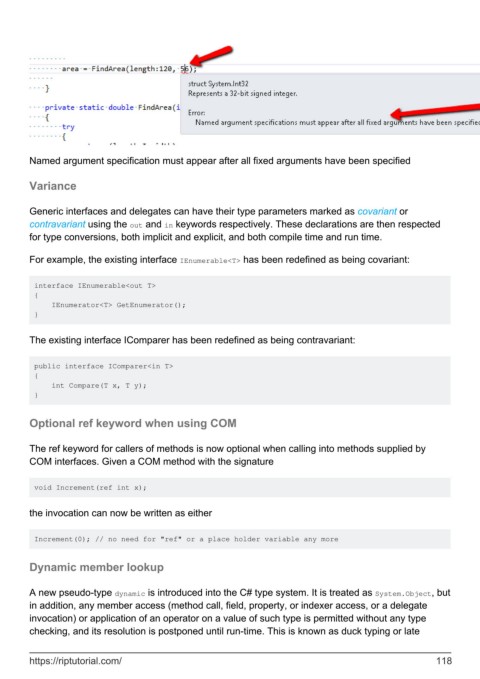
Named argument specification must appear after all fixed arguments have been specified


        Variance


        Generic interfaces and delegates can have their type parameters marked as covariant or
        contravariant using the out and in keywords respectively. These declarations are then respected
        for type conversions, both implicit and explicit, and both compile time and run time.


        For example, the existing interface IEnumerable<T> has been redefined as being covariant:


         interface IEnumerable<out T>
         {
             IEnumerator<T> GetEnumerator();
         }


        The existing interface IComparer has been redefined as being contravariant:


         public interface IComparer<in T>
         {
             int Compare(T x, T y);
         }


        Optional ref keyword when using COM


        The ref keyword for callers of methods is now optional when calling into methods supplied by
        COM interfaces. Given a COM method with the signature


         void Increment(ref int x);


        the invocation can now be written as either


         Increment(0); // no need for "ref" or a place holder variable any more


        Dynamic member lookup


        A new pseudo-type dynamic is introduced into the C# type system. It is treated as System.Object, but
        in addition, any member access (method call, field, property, or indexer access, or a delegate
        invocation) or application of an operator on a value of such type is permitted without any type
        checking, and its resolution is postponed until run-time. This is known as duck typing or late


        https://riptutorial.com/                                                                             118

