


Page 189 - CSharp/C#
P. 189
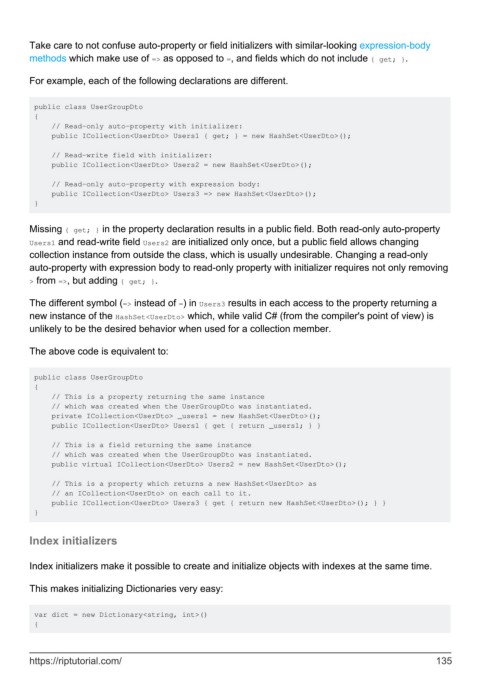
Take care to not confuse auto-property or field initializers with similar-looking expression-body
        methods which make use of => as opposed to =, and fields which do not include { get; }.


        For example, each of the following declarations are different.


         public class UserGroupDto
         {
             // Read-only auto-property with initializer:
             public ICollection<UserDto> Users1 { get; } = new HashSet<UserDto>();

             // Read-write field with initializer:
             public ICollection<UserDto> Users2 = new HashSet<UserDto>();

             // Read-only auto-property with expression body:
             public ICollection<UserDto> Users3 => new HashSet<UserDto>();
         }


        Missing { get; } in the property declaration results in a public field. Both read-only auto-property
        Users1 and read-write field Users2 are initialized only once, but a public field allows changing
        collection instance from outside the class, which is usually undesirable. Changing a read-only
        auto-property with expression body to read-only property with initializer requires not only removing
        > from =>, but adding { get; }.

        The different symbol (=> instead of =) in Users3 results in each access to the property returning a
        new instance of the HashSet<UserDto> which, while valid C# (from the compiler's point of view) is
        unlikely to be the desired behavior when used for a collection member.


        The above code is equivalent to:


         public class UserGroupDto
         {
             // This is a property returning the same instance
             // which was created when the UserGroupDto was instantiated.
             private ICollection<UserDto> _users1 = new HashSet<UserDto>();
             public ICollection<UserDto> Users1 { get { return _users1; } }

             // This is a field returning the same instance
             // which was created when the UserGroupDto was instantiated.
             public virtual ICollection<UserDto> Users2 = new HashSet<UserDto>();

             // This is a property which returns a new HashSet<UserDto> as
             // an ICollection<UserDto> on each call to it.
             public ICollection<UserDto> Users3 { get { return new HashSet<UserDto>(); } }
         }


        Index initializers


        Index initializers make it possible to create and initialize objects with indexes at the same time.


        This makes initializing Dictionaries very easy:


         var dict = new Dictionary<string, int>()
         {


        https://riptutorial.com/                                                                             135

