


Page 129 - CSharp/C#
P. 129
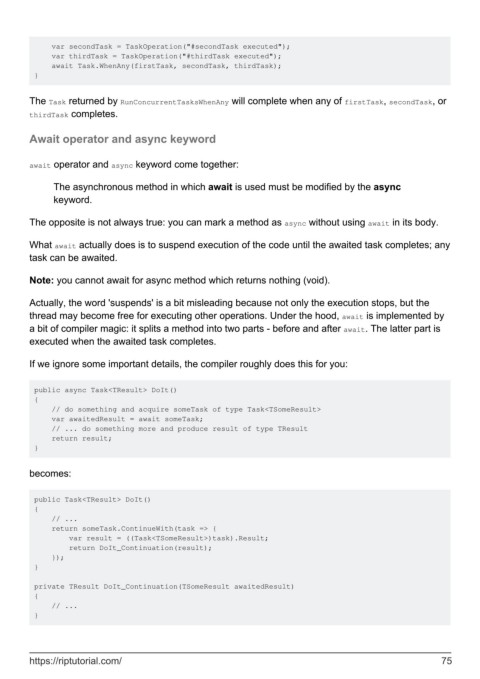
var secondTask = TaskOperation("#secondTask executed");
             var thirdTask = TaskOperation("#thirdTask executed");
             await Task.WhenAny(firstTask, secondTask, thirdTask);
         }


        The Task returned by RunConcurrentTasksWhenAny will complete when any of firstTask, secondTask, or
        thirdTask completes.


        Await operator and async keyword


        await operator and async keyword come together:

              The asynchronous method in which await is used must be modified by the async
              keyword.


        The opposite is not always true: you can mark a method as async without using await in its body.

        What await actually does is to suspend execution of the code until the awaited task completes; any
        task can be awaited.


        Note: you cannot await for async method which returns nothing (void).

        Actually, the word 'suspends' is a bit misleading because not only the execution stops, but the
        thread may become free for executing other operations. Under the hood, await is implemented by
        a bit of compiler magic: it splits a method into two parts - before and after await. The latter part is
        executed when the awaited task completes.


        If we ignore some important details, the compiler roughly does this for you:


         public async Task<TResult> DoIt()
         {
             // do something and acquire someTask of type Task<TSomeResult>
             var awaitedResult = await someTask;
             // ... do something more and produce result of type TResult
             return result;
         }


        becomes:


         public Task<TResult> DoIt()
         {
             // ...
             return someTask.ContinueWith(task => {
                 var result = ((Task<TSomeResult>)task).Result;
                 return DoIt_Continuation(result);
             });
         }

         private TResult DoIt_Continuation(TSomeResult awaitedResult)
         {
             // ...
         }


        https://riptutorial.com/                                                                               75

