


Page 200 - CSharp/C#
P. 200
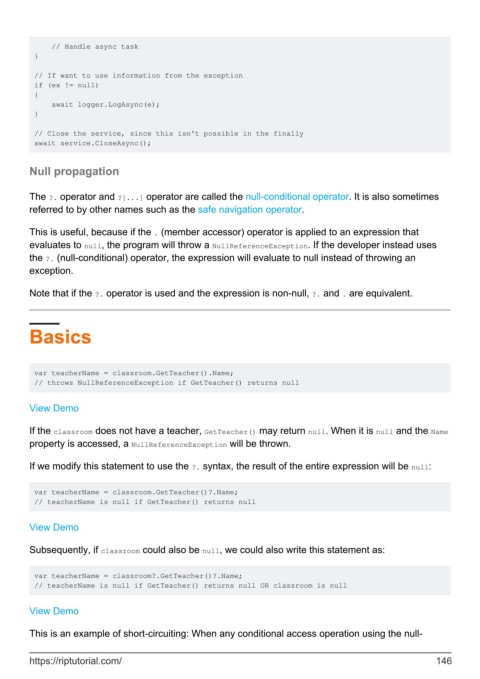
// Handle async task
         }

         // If want to use information from the exception
         if (ex != null)
         {
             await logger.LogAsync(e);
         }

         // Close the service, since this isn't possible in the finally
         await service.CloseAsync();


        Null propagation


        The ?. operator and ?[...] operator are called the null-conditional operator. It is also sometimes
        referred to by other names such as the safe navigation operator.

        This is useful, because if the . (member accessor) operator is applied to an expression that
        evaluates to null, the program will throw a NullReferenceException. If the developer instead uses
        the ?. (null-conditional) operator, the expression will evaluate to null instead of throwing an
        exception.


        Note that if the ?. operator is used and the expression is non-null, ?. and . are equivalent.


        Basics


         var teacherName = classroom.GetTeacher().Name;
         // throws NullReferenceException if GetTeacher() returns null


        View Demo

        If the classroom does not have a teacher, GetTeacher() may return null. When it is null and the Name
        property is accessed, a NullReferenceException will be thrown.


        If we modify this statement to use the ?. syntax, the result of the entire expression will be null:


         var teacherName = classroom.GetTeacher()?.Name;
         // teacherName is null if GetTeacher() returns null


        View Demo


        Subsequently, if classroom could also be null, we could also write this statement as:


         var teacherName = classroom?.GetTeacher()?.Name;
         // teacherName is null if GetTeacher() returns null OR classroom is null


        View Demo


        This is an example of short-circuiting: When any conditional access operation using the null-


        https://riptutorial.com/                                                                             146

